A men’s lace hair system uses a mesh base (often Swiss or French lace, sometimes lace-front only) that can disappear into a soft hairline when knots and adhesive are managed well. A men’s thin-skin (polyurethane / poly) system uses a skin-like film base that can mimic scalp at the edge and often simplifies tape cleanup — usually at the cost of breathability and, on very thin films, published wear life. This page compares those two base families so you can choose by lifestyle, not by slogan.
We compared public merchant education and product category pages — not private lab wear-tests — and organized the tradeoffs around the decision gates that usually change the purchase: heat and sweat, hairline realism, adhesive cleanup, shine under hard light, and beginner maintenance load. Specs below are labeled Public specs (as published; verify on brand site).
Public specs comparison
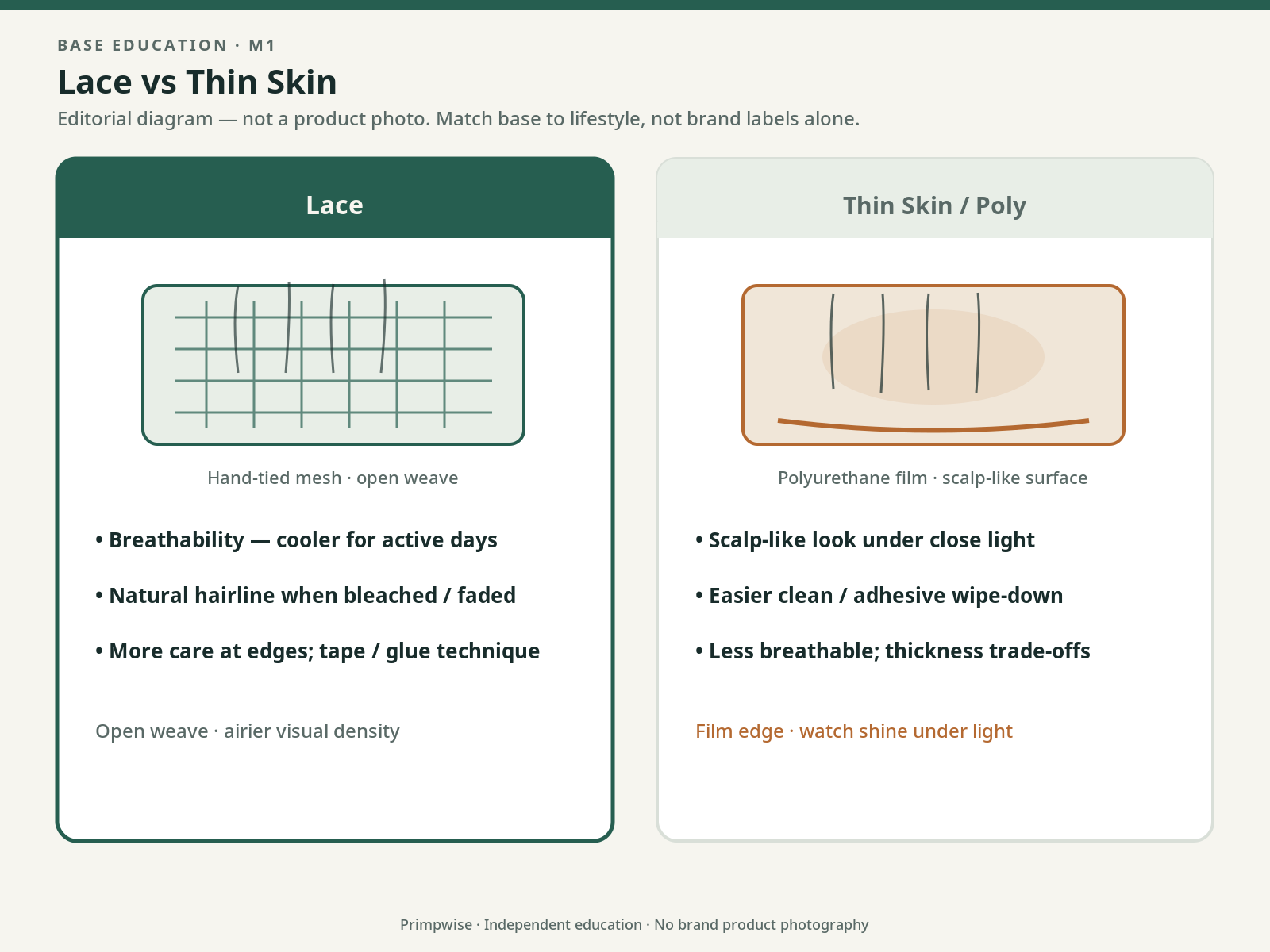
Public specs (as published; verify on brand site). Brand names below are category examples from shortlisted men’s sellers, not a scored ranking.
| Dimension | Lace (Swiss / French / lace front) | Thin skin / poly (incl. V-loop) |
|---|---|---|
| Base look | Mesh that can read as a soft hairline when knots are managed | Scalp-like film edge; can look very “skin” up close |
| Breathability | Typically highest among common men’s bases | Typically lower; full-poly can trap heat/sweat |
| Maintenance / cleanup | Adhesive on lace can tear or yank hair if removed carelessly | Often easier tape/glue cleanup on poly edges |
| Lifespan (public framing) | Delicate mesh; care and adhesive technique drive wear | Thinner films often framed as more natural and shorter published cycles |
| Best if… | Heat, sport, sweat, or hairline-first close inspection | Simpler attach/clean workflow; scalp-like edge priority |
| Watch-outs | Knot visibility; lace-edge tear; learning curve on adhesive | Shine under light; lower breathability; ultra-thin = careful handling |
| Shop starting points | Lordhair lace · Superhairpieces lace · LaVivid lace | Lordhair SuperSkin-V (thin skin) · Superhairpieces thin skin · LaVivid thin skin |
Public brand education is consistent on the core fork. Lordhair’s skin-systems comparison frames skin vs lace vs mono on breathability, naturality, durability, and maintenance, and positions a thin V-loop skin stock unit (SuperSkin-V, about 0.06 mm, medium-light 100% density on the stock listing) as a common beginner-oriented thin-skin entry — still verify thickness, density, and returns on the live card (Lordhair SuperSkin-V). Superhairpieces’ density guide notes that the same density percentage often looks lighter on thin skin / Swiss lace and heavier on mono, so percentage labels are not cross-comparable across bases or brands (SHP density guide). Superhairpieces’ thin-skin bestsellers education is another public stock-model surface for film-base beginners — still verify thickness and density on the live card (SHP thin-skin bestsellers). LaVivid’s public cost article discusses lace, skin, and monofilament categories with published price bands (not a cheapest claim) that you should re-check live (LaVivid cost article).
For multi-brand context beyond this base fork, see the men’s hair system shortlist.
If breathability, sport, or hairline-first realism dominate → lace
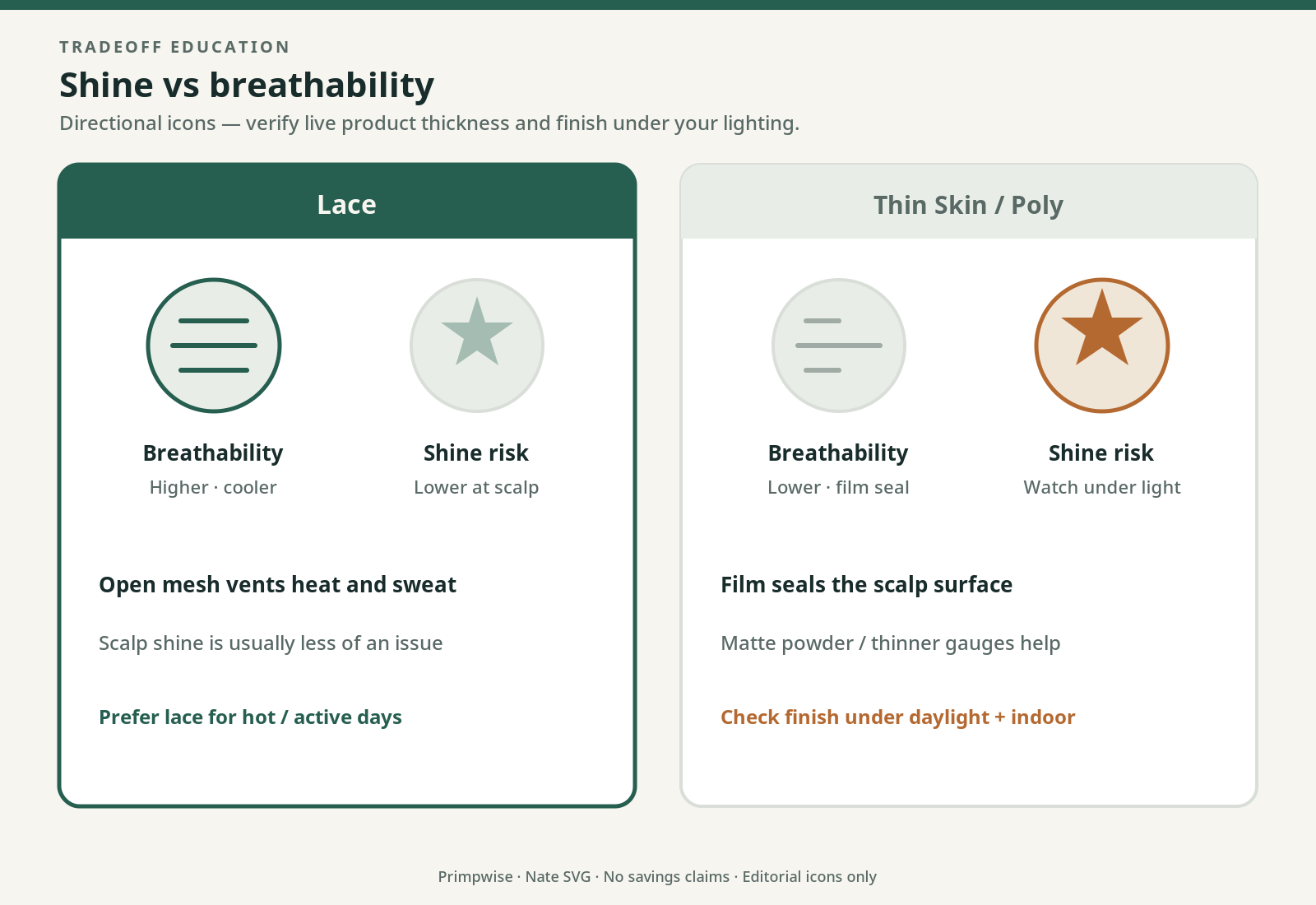
Choose lace (full lace or lace-front constructions) when heat and sweat are primary objections, or when the front hairline must survive close inspection in bright light. Mesh lets air move; a well-managed lace front can look softer than a thick poly edge. The tradeoff is technique: adhesive on lace edges can tear mesh or pull hair if removed aggressively, and unbleached or poorly placed knots can telegraph “system” even when density is fine.
Practical editorial bias for lace-first buyers:
- Prioritize knot strategy and adhesive placement over chasing the thinnest advertised lace alone.
- Budget time (or a stylist) for a believable cut-in; an uncut stock lace unit will still look like a unit.
- If you also want poly where tape sits, a hybrid (lace + poly edges) is a third path — not covered as a full vs page here, but worth knowing before you lock a pure lace or pure skin order.
- When you later shortlist lace SKUs across brands, use the best lace hair systems for men roundup rather than mixing random lace and skin cards.
Shop lace collections: Lordhair lace systems · Superhairpieces lace systems · LaVivid lace systems
When you are ready to pick which lace SKUs to shortlist across brands, use the companion best lace hair systems for men roundup (Best-of = who to buy; this page = lace vs skin tradeoffs).
If easier cleanup, scalp-like edge, or simpler beginner maintenance dominate → thin skin

Thin skin / poly bases are frequently positioned for easier tape and glue cleanup and a scalp-like perimeter. Community decision themes around base choice often land here when someone is tired of lace-edge adhesive mess or wants a film edge that reads as skin under casual viewing. Public tradeoff language across sellers is also consistent: thinner films often look more natural and carry shorter published wear cycles; thicker poly can last longer but shine more at the hairline under hard light.
Practical editorial bias for thin-skin-first buyers:
- Start with a stock thin-skin unit in a light / light–medium density band when learning attach and clean — ultra-thin custom is a poor first classroom.
- Expect shine management (matte powders, careful edge placement, lighting checks) as part of the workflow, not a rare edge case.
- If sport and heat matter more than cleanup simplicity, re-read the lace branch before ordering a full-poly base.
- After thin skin is locked as the family, shortlist models via best thin skin hair systems for men rather than mixing lace cards into the cart.
Shop thin-skin collections: Lordhair SuperSkin-V · Superhairpieces thin-skin systems · LaVivid skin systems
For brand-level thin-skin shortlists after you pick the base family, see best thin skin hair systems for men.
Density and “wiggy” look still beat brand slogans
Base choice does not rescue an over-dense unit. Community themes around unnatural look repeatedly point to density that is too high for bio hair on the sides and back, an unfinished cut, base shine, or color mismatch. Public stylist guidance from major sellers leans lighter for first units, and reminds buyers that the same percentage reads differently on lace, thin skin, and mono. Match bio hair first; then let lace vs thin skin settle breathability and cleanup.
If you are still mapping base, density, budget, and install skill together, use the decision tree in how to choose a hair system.
Lace vs mono is a different fork
Lace vs thin skin is mostly breathability / hairline vs cleanup / scalp-edge. Lace vs mono is a different comparison — durability and visual density on monofilament tops versus mesh breathability. Do not treat mono as “just thicker lace.” When that is your fork, read lace vs mono hair systems for men.
FAQ
Is lace or thin skin better for beginners?
If the priority is easier cleanup and a simpler edge workflow, thin skin / poly (including V-loop stock) is a common starter path in brand education. If the priority is breathability and a lace hairline, start with lace or a lace-front hybrid and learn adhesive technique carefully. There is no universal winner — pick the friction you would rather manage.
Does thin skin always look more natural than lace?
Not always. Thin skin can look very scalp-like at the edge, but shine under hard light and lower breathability are common watch-outs. Lace can look softer at the hairline when knots and adhesive are managed. Lighting, cut, density, and color usually matter as much as base family.
Will a lace system handle workouts better?
Lace is typically framed as the more breathable option for heat and sweat. Technique still matters: a poorly bonded lace edge can lift during sport. If you need poly where tape sits plus lace at the front, evaluate hybrid constructions rather than forcing a pure base.
How long do lace and thin-skin systems last?
Published wear life varies by thickness, adhesive habits, wash frequency, and how aggressively the unit is cleaned. Brand education often pairs thinner / more natural thin-skin films with shorter published cycles. Treat lifespan claims on the live listing as directional, not a guarantee, and budget replacement as part of total cost.
Should I buy lace Best-of lists or this comparison first?
Use this page to decide lace vs thin skin. Use the lace and thin-skin Best-of roundups to decide which brands and SKUs to shortlist after the base fork is clear. Then verify price, returns, and density on the live product page.
Closing — choose the friction you can live with
- Decide whether breathability / hairline or cleanup / scalp-edge matters more day to day.
- Pick density for bio-hair match (start lighter if unsure).
- Shortlist two brands that publish the base you chose — lace collections or thin-skin collections, not a mixed random cart.
- Confirm thickness, density label, returns, and lifespan language on the live listing.
- Budget a professional first cut-in when possible.
If base family is settled but budget, beginner path, or install channel is still open, walk the decision tree in how to choose a hair system. For the full multi-brand men’s roundup and conditional brand notes, return to the men’s hair system shortlist.
Image credits: Cover photo: Stock photo: Nenad Stojkovic / Wikimedia Commons, CC BY 2.0 (resized).
Diagrams: self-drawn by Polishwise.
Product images from LaVivid, Lordhair, and Superhairpieces product pages, linked to the source pages.
Product images are merchant images, not photos taken by this site.