Choosing a first men’s hair system is less about memorizing every SKU name and more about locking four decisions in order: base material, density, color, and size / stock-vs-custom—then picking an install channel (DIY or salon) that matches skill and access. Brand shortlists come after those gates. This guide is an independent decision tree for Primpwise readers; specs and price bands are Public specs (as published; verify on brand site).
We organized the steps around the friction points that usually stall or wreck first orders: lace vs thin skin tradeoffs, density that reads “wiggy,” color that looks too dark once bonded, stock size vs custom lead time, and whether the first cut-in should be DIY or salon. For multi-brand product tables after you know your gates, continue to the men’s hair system shortlist.
Decision order (do not reverse it)
- Base — lace, thin skin / poly, hybrid, or mono (lifestyle + maintenance).
- Density — match bio hair on the sides/back; start lighter if unsure.
- Color — match sides/back in daylight; when between shades, bias lighter.
- Size / stock vs custom — measure coverage area; prefer stock while learning unless specs force custom.
- Install channel — salon first cut-in vs full DIY.
- Brand shortlist — two merchants that publish the base + texture you need.
Skipping ahead to “which brand is best” without base and density is how first orders become returns—or permanent cut mistakes.
Decision 1: Base material
Public category language across men’s sellers converges on a familiar tradeoff: more undetectable hairlines and thinner films often mean more delicate handling and shorter published wear cycles; more durable bases often look denser or less “scalp-like” at the edge.
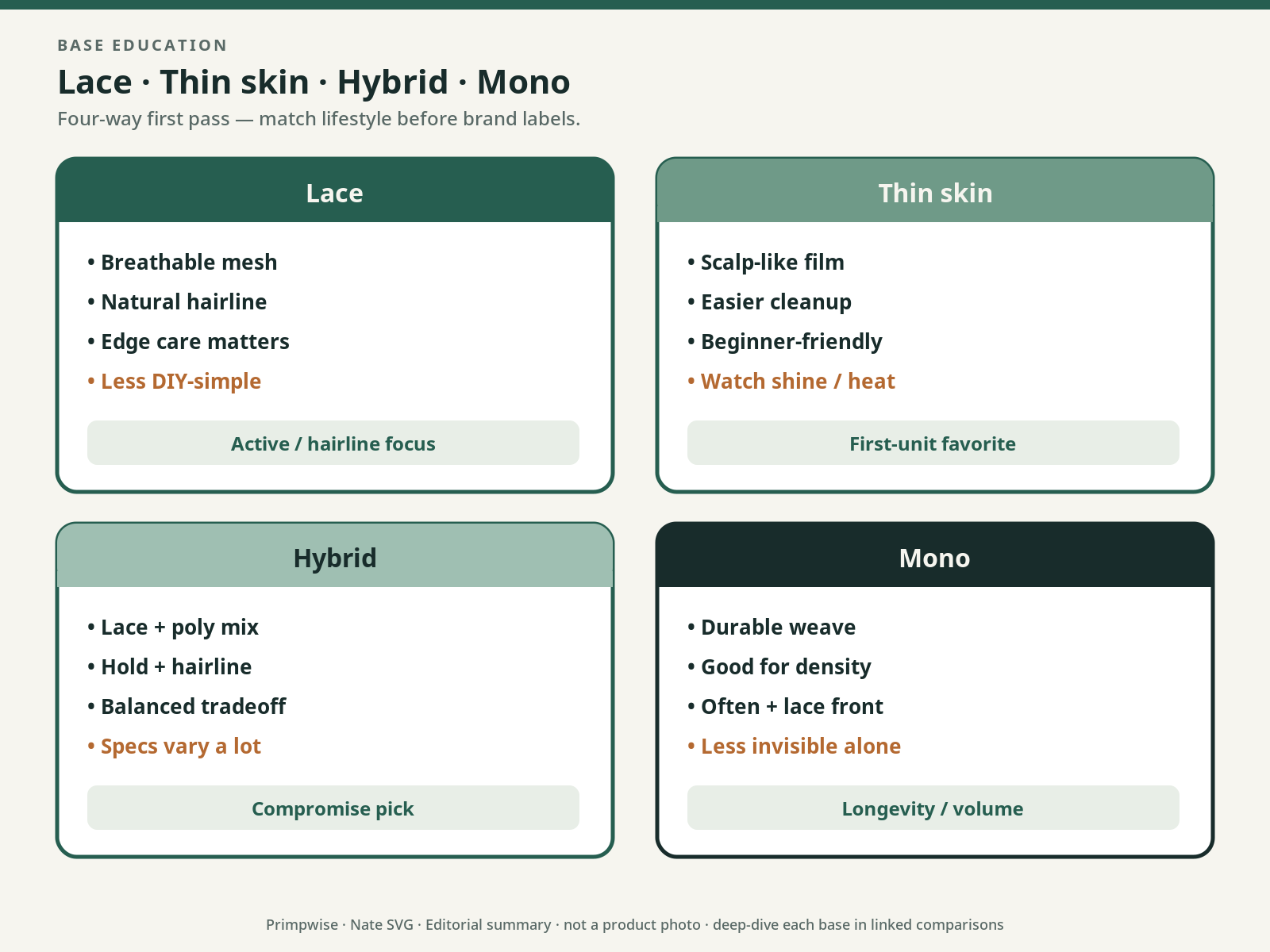
| Base (public category) | Strong when… | Watch-outs | Deep compare |
|---|---|---|---|
| Lace (Swiss / French / lace front) | Heat, sport, sweat; hairline-first close inspection | Knot visibility; adhesive tear on lace edges; steeper DIY cleanup | Lace vs thin skin |
| Thin skin / poly (incl. V-loop) | Simpler tape/glue cleanup; scalp-like edge; many beginner stock paths | Shine under hard light; lower breathability; ultra-thin = careful handling | Same M1 page |
| Hybrid (lace + poly edges, etc.) | Want lace front with tougher tape perimeter | Zone-specific care; cut-to-size complexity | Covered in C1 base table |
| Mono / monofilament tops | Durability; some Afro / fuller styles | Can read heavier at the same % vs lace/skin | Texture-specific listings |
Editorial bias for most first-time buyers who will self-reattach: a stock thin-skin or forgiving hybrid is easier to learn than ultra-delicate lace edges—unless breathability or hairline goals force lace, in which case budget practice time or a salon attach. Full material tradeoffs live on lace vs thin skin hair systems.
Lordhair’s public beginner framing around a V-loop thin-skin stock unit (SuperSkin-V) is one commonly cited stock entry narrative (SuperSkin-V). Superhairpieces publishes thin-skin and lace hubs plus density education beginners use before buying (SHP density guide). LaVivid’s cost article discusses lace / skin / mono categories as published education (LaVivid cost article).

If lace / breathability: Lordhair lace · Superhairpieces lace · LaVivid lace
If thin skin / simpler cleanup: Lordhair SuperSkin-V · Superhairpieces thin skin · LaVivid thin skin
Optional Best-of spokes when you already know the base family: best lace hair systems for men · best thin skin hair systems for men.
Decision 2: Density
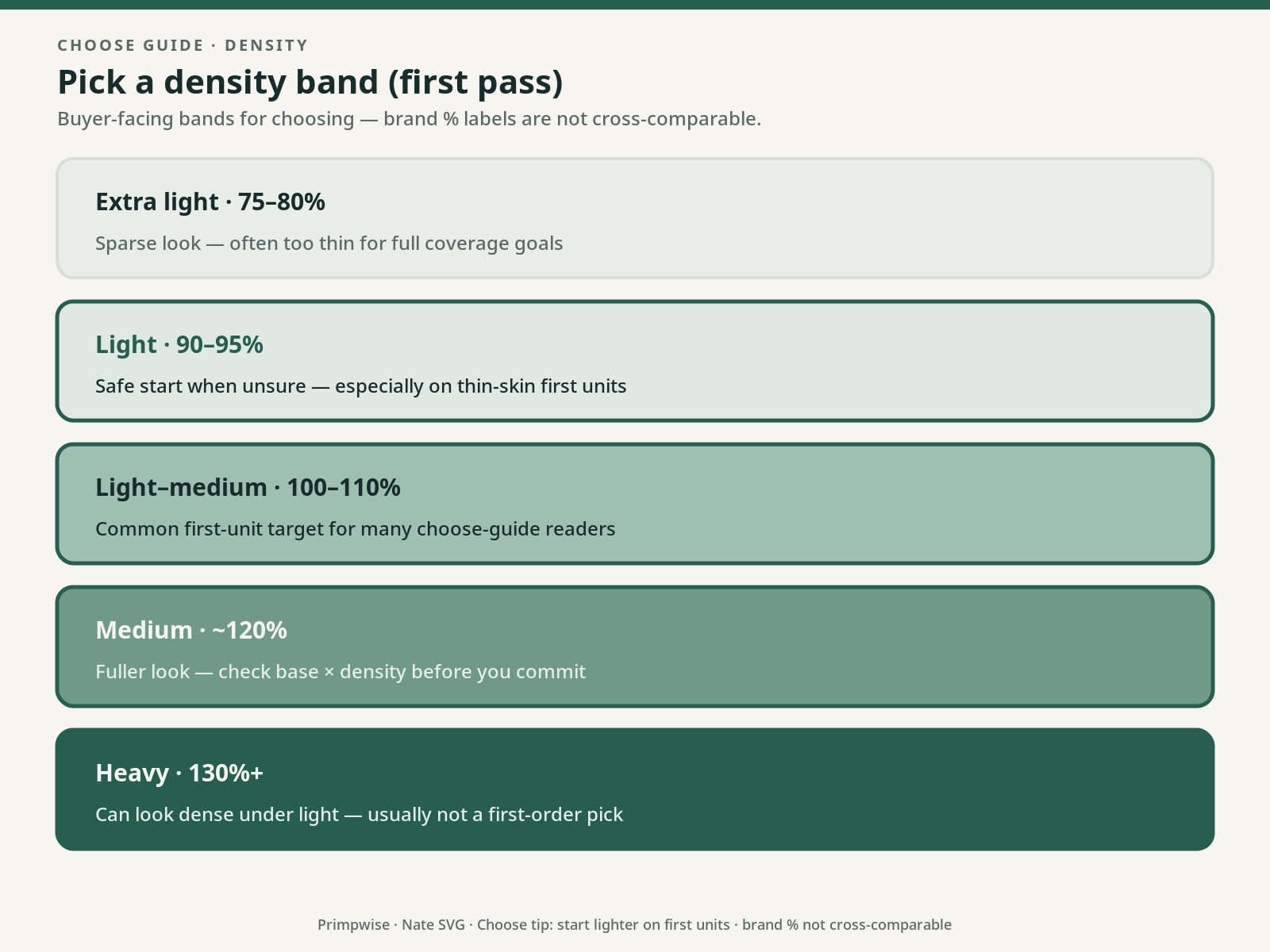
Density is the fastest path to an unnatural look when it is too high for bio hair. Public stylist education from Superhairpieces classifies rough bands (extra light ~75–80%, light ~90–95%, light–medium ~100–110%, medium ~120%, heavy 130%+) and stresses that the same percentage looks lighter on thin skin / Swiss lace and heavier on mono, and that brand percentages are not cross-comparable (density guide).
Editorial rules:
- First units: prefer light / light–medium unless bio hair clearly supports more.
- Over 50 or visibly thin sides: bias lighter so the piece does not sit “on top of the head.”
- Curly / Afro fiber reads fuller at the same percentage — do not copy a straight-fiber density default.
- Never “fix” density with aggressive thinning shears on a first unit without skill — permanent damage is a real risk theme.
Decision 3: Color
Color-match themes repeatedly warn that systems can read darker once bonded than they look in a photo. Match to the sides and back in natural daylight—not to the thinning crown memory of “how dark I used to be.”
Common public color codes (verify on each brand’s chart):
- #1B — natural off-black (common for many dark / Asian bio hair references)
- #2 — darkest brown
- #4 — medium-dark brown
- #1B10 / #1B20 — off-black with grey blend when salt-and-pepper is present
When between two shades, order the lighter one. Grey-blend and dye options vary by merchant—confirm on the live listing rather than assuming every stock ladder includes the same mixes.
Decision 4: Size, stock, or custom
Measure the bald / thinning coverage area (front-to-back length and side-to-side width) before ordering. Many men’s stock bases ship in common rectangles (often discussed around 8″ × 10″ industry stock) that can be cut down; unusual shapes, full-cap needs, or specs outside stock ladders push toward custom.
| Path | Choose when… | Watch-outs |
|---|---|---|
| Stock | Learning, testing density/color, need speed, standard pattern | Cutting mistakes; wrong stock size |
| Custom | Coverage or contour exceeds stock; hard color/curl/gradient specs | Lead time; stricter final-sale rules; measurement error |
Deep fork: stock vs custom hair systems. Custom CTAs only when stock cannot meet the spec: LaVivid custom (and brand custom forms on Lordhair / SHP — verify live lead times).
Decision 5: DIY vs salon install
Install channel is independent of brand. Salon-first usually wins for the first cut-in and hard hairline goals; DIY wins when budget or geography blocks a system-literate stylist and the wearer will practice. Hybrid paths (salon cut-in, DIY reattach) are common.
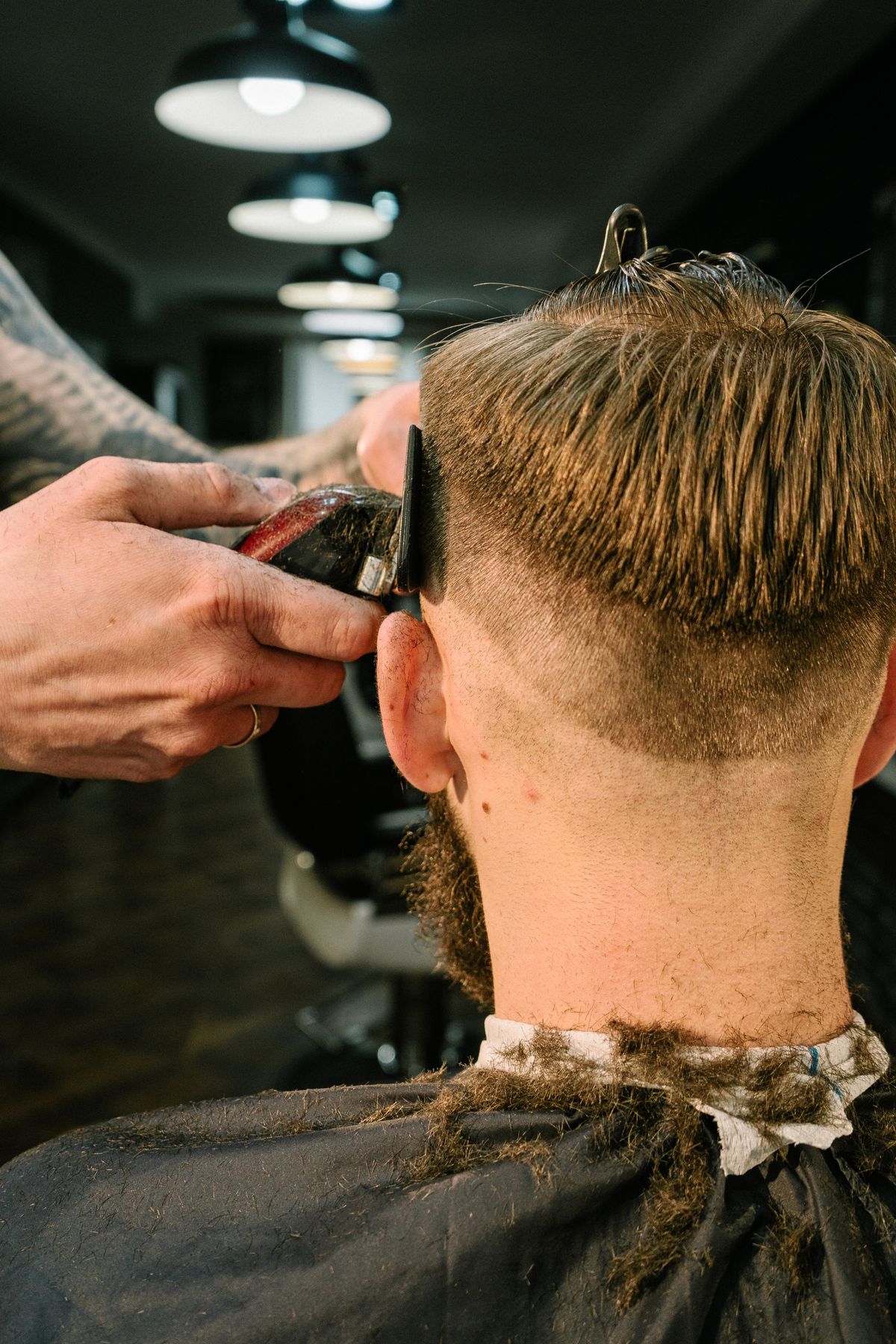
Full compare: DIY vs salon hair system install. Beginner product framing also sits on best hair systems for beginners.
Conditional shortlists (after the five gates)
If beginner + DIY + cleanup simplicity → stock thin skin, light density
Lordhair SuperSkin-V · Superhairpieces thin skin · LaVivid thin skin
If heat / sport / hairline-first → lace or lace-front hybrid
Lordhair lace · Superhairpieces lace · LaVivid lace
If budget is the primary filter → stock first, then budget Best-of
Read return rules for unworn/uncut pieces. Continue with best budget hair systems for men and the cost breakdown so adhesives and replacement cycles are in the plan—not only unit stickers. Public unit signals (verify live): Lordhair SuperSkin-V observed around $249; LaVivid published lace/skin/mono bands on its cost article; SHP shelf prices = live listing only.
If Afro / kinky coils → texture-matched stock or custom
Match curl diameter and color (#1 / #1B neighbors); curly fiber reads fuller at the same density %. Use Afro hubs and barber cut-in experience. Lordhair’s Afro hub is one public catalog starting point; verify Superhairpieces / LaVivid Afro-capable listings live. Custom when stock curl ladders miss: LaVivid custom.
If still deciding surgery vs system → pause the cart
Systems and transplants solve different problems. Read hair system vs hair transplant before paying for either path. Medical eligibility belongs with a clinician.
Comfort gates: heat, itch, and hold
Buying guides that only discuss look miss the comfort objections that make wearers quit:
- Heat / sweat — favors lace or more breathable constructions; full poly can feel hotter in gym and humid climates.
- Itch / sensitivity — may be adhesive chemistry, residue, or base edge pressure rather than “the hair.” Patch-test adhesives when possible; distinguish irritation from true allergy with a clinician if symptoms persist.
- Hold failure — often technique, oil, or wrong adhesive for the base—not only a “bad brand.” Lace edges and ultra-thin skins punish rough removal.
If comfort is the primary fear, choose base and adhesive with maintenance honesty first, then optimize hairline photos second.
What “natural” actually requires
Undetectability is a system of decisions, not a brand slogan. Buyer themes around unnatural look repeatedly cite: density too high, unfinished cut, poly shine, lace knots, and color mismatch. A cheaper unit with correct density and a good cut usually beats an expensive unit worn uncut at 130% density. Budget for scissors in skilled hands—or a stylist who has cut systems—before upgrading to custom lace fronts.
Public price education (verify live) helps set expectations without crowning a cheapest brand: Lordhair SuperSkin-V list signals around $249; LaVivid’s published lace/skin/mono bands on its cost article; Superhairpieces unit shelves from live product pages only. Maintenance and cut-in often rival the unit in year-one spend.
Vendor shortlist without a single winner
After gates are locked, shortlist two merchants from the common men’s pool that publish your base and texture: Lordhair, LaVivid, Superhairpieces, and (where men’s HS pages are live) UniWigs. Compare return windows, shipping regions, adhesive accessory availability, and whether stock photos match the density label you need. Multi-brand tables live on the 2026 men’s shortlist; pairwise brand fights are not required to place a first order.
First-order checklist
- [ ] Bald area measured (length × width)
- [ ] Base chosen for lifestyle (not only Instagram hairline)
- [ ] Density chosen lighter if unsure; curl adjustment considered
- [ ] Color matched to sides/back in daylight (lighter if between shades)
- [ ] Stock vs custom decided with lead time and return rules read
- [ ] Install channel booked or DIY kit planned
- [ ] Two merchants shortlisted that publish the needed base
- [ ] Live price, lifespan language, and unworn/uncut return window verified
FAQ
What is the best hair system for a first-time buyer?
There is no universal SKU. Most beginners do best with a stock unit in light / light–medium density on a base they can actually maintain—often thin skin for cleanup simplicity, or lace if breathability/hairline force it—and a plan for a professional first cut-in when possible.
Do first-time buyers need a salon?
Not always, but the first cut-in is where permanent mistakes happen. Salon-first or hybrid (salon cut, DIY reattach) reduces that risk. See DIY vs salon.
How should color be chosen?
Match sides and back in daylight; bias lighter when between shades; use grey-blend codes when salt-and-pepper is present. Do not match to an old photo of denser hair without checking undertone.
When is custom worth it on order one?
When coverage shape, curl, or gradient clearly exceeds stock ladders. Otherwise learn on stock—see stock vs custom.
How much should a first system budget include?
Unit sticker plus adhesive kit, possible salon cut-in, and a mental budget for a learning mistake if returns require unworn condition. Use the cost breakdown for ownership themes across base types.
Closing — lock gates, then shop two listings
- Base → density → color → size path → install channel.
- Open two live merchant pages that publish those specs.
- Verify price, returns, and care language.
- Cut once with a system-literate plan.
- Adjust on unit two—do not expect unit one to be perfect.
Shop by branch: thin skin CTAs and lace CTAs above · custom LaVivid custom · hub shortlist best hair systems for men 2026.
Image credits: Cover photo: Stock photo: Daderot / Wikimedia Commons, CC0 (resized); Barber photo: Stock photo: Antoni Shkraba / Pexels.
Diagrams: self-drawn by Polishwise.
Product images from Lordhair product pages, linked to the source pages.
Product images are merchant images, not photos taken by this site.