A men’s hair system’s sticker price is only the first invoice. Total cost of ownership (TCO) also includes adhesives and removers, shampoo/conditioner suitable for bonded hair, optional salon cut-ins and reattaches, shipping/duties, and—most of all—how often the base must be replaced. This page breaks those layers using multi-merchant public price education, not a single factory’s promotional band presented as market truth.
We compared public product pages and brand cost articles from Lordhair, LaVivid, and Superhairpieces, and organized ownership themes around buyer questions about annual spend, lifespan, and whether systems undercut transplant cash outlays. Figures below are Public specs (as published; verify on brand site) unless labeled commonly cited clinic ranges. For product shortlists after budget gates, see the men’s hair system shortlist.
Layer 1 — Upfront unit price (multi-merchant)
| Source | Public signal (verify live) | What it covers | Proof |
|---|---|---|---|
| Lordhair SuperSkin-V stock | About $249 USD list observed on the product page (currency switcher present) | One stock thin-skin / V-loop unit example | SuperSkin-V |
| Lordhair Afro hub tiles | Roughly $149–$309 depending on model (public tiles) | Texture-specific stock range examples | Afro hub |
| LaVivid cost article | Lace roughly $250–$290; skin types roughly $100–$299; monofilament roughly $190–$350 (brand education bands) | Category bands + service/transplant context on-page | LaVivid cost article |
| Superhairpieces | Thin-skin bestsellers emphasize models/features; promo language may cite cart thresholds — unit shelf prices: check live listing (unverified as a stable shelf band in this pass) | Education-first; cart price from PDP | SHP thin-skin bestsellers |
Editorial reading: many men’s stock units from shortlisted merchants land in the low hundreds of USD for the piece alone, with lace/skin/mono bands overlapping across brands. That is a range, not a promise that every good unit is $X. Custom orders usually price higher and add lead time—see stock vs custom hair systems.
Do not treat any one merchant’s “$100–$300 stock” marketing line as the exclusive market floor or ceiling without cross-checking live listings.
Layer 2 — Accessories and care (every base)
Annual accessory spend is often smaller than unit replacement but non-zero. Buyer maintenance themes typically include:
- Tape rolls or liquid bond
- Adhesive remover / solvent
- Scalp prep (alcohol or brand prep)
- Sulfate-conscious shampoo / conditioner / leave-in aimed at system hair
- Optional: knot sealer, shine control for poly, travel kits
Directional planning budget used in this guide: roughly $100–$200 / year for adhesives and wash products for many DIY wearers—unverified as a universal tariff; heavy gym sweat or salon-only attaches change the mix. Salon product markups differ from home kits.
Layer 3 — Salon labor (optional but common)
System-literate cut-ins and reattaches are a separate line item from the unit. Public buyer discussion and brand service context (including LaVivid’s cost education mentioning service bundles) imply that labor can rival or exceed adhesives over a year if every cycle is salon-only. Exact city menus vary too widely to invent here—ask local stylists for system-specific pricing.
Cost-control pattern: pay for a professional first cut-in, then DIY reattach if skill allows (DIY vs salon).
Layer 4 — Replacement cycles (the TCO driver)
Lifespan language is merchant- and care-dependent. Public framing across the category often presents:
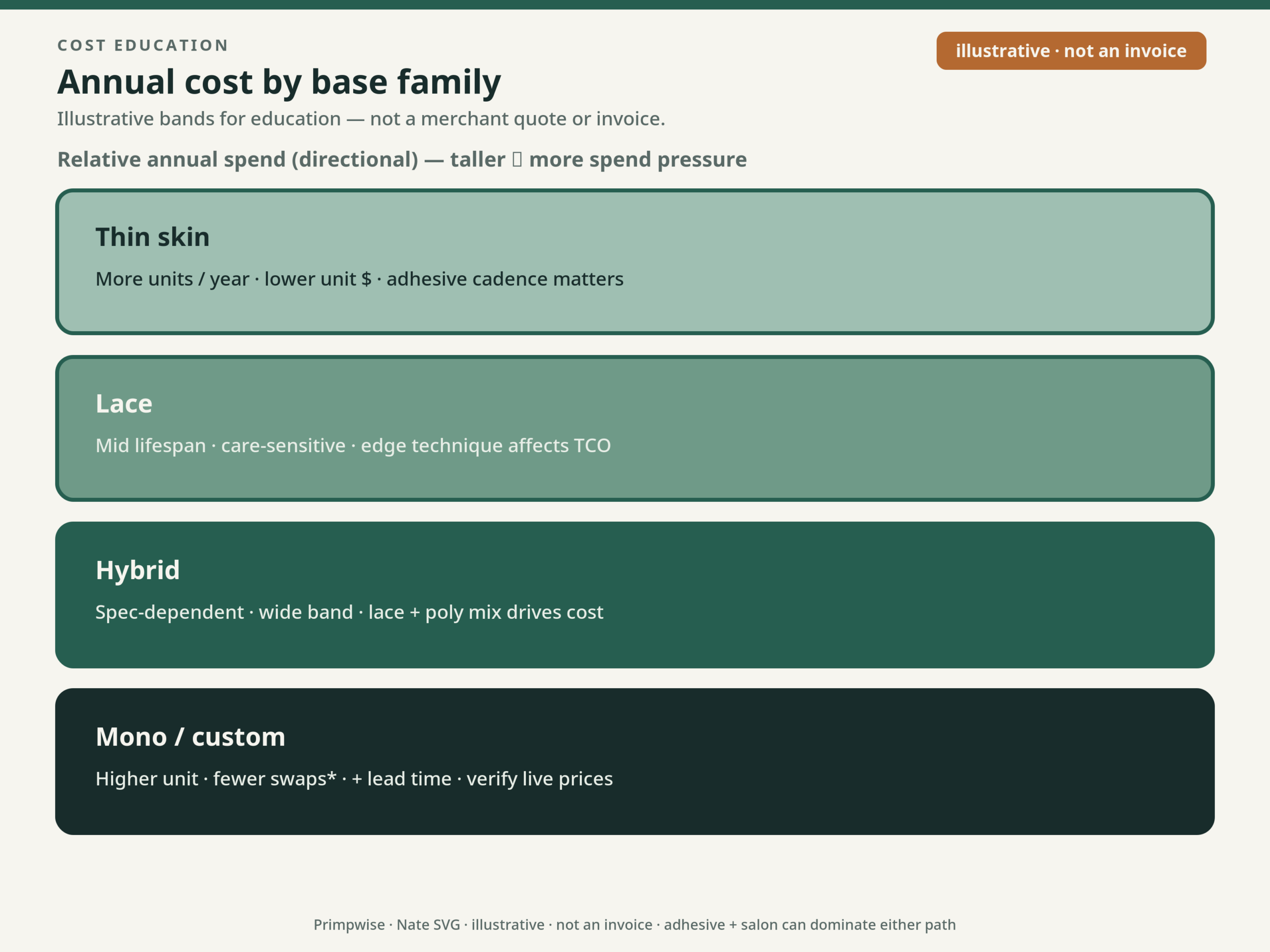
| Base family (public framing) | Directional wear-cycle theme | TCO implication |
|---|---|---|
| Ultra-thin poly / thin skin | Shorter published cycles; more natural film look | More units / year if that framing holds for your care |
| Lace | Mid cycles; care and adhesive technique sensitive | Unit count moderate; lace damage can force early retire |
| Hybrid | Mid cycles; zone care | Balanced if perimeter and lace zones are maintained |
| Mono / durable tops | Longer published cycles | Fewer units / year; density/weight tradeoffs |
These are not single-merchant guarantees and not universal clocks. Sweat, swimming, rough removal, and hard water change outcomes. Community lifespan complaints often trace to cleaning mistakes or ultra-thin films worn past integrity—not only to “cheap hair.”
Directional annual unit math (illustrative)
Assume a mid-band unit cost of ~$200–$250 (verify live) and accessory ~$150:
| Scenario | Units / year (illustrative) | Units $ | + Accessories | Ballpark annual |
|---|---|---|---|---|
| Short-cycle thin skin | 6–10 | $1,200–$2,500 | ~$150 | ~$1,350–$2,650 |
| Mid-cycle lace / hybrid | 2–4 | $400–$1,000 | ~$150 | ~$550–$1,150 |
| Longer-cycle mono | 1–2 | $200–$500 | ~$150 | ~$350–$650 |
Add salon labor if applicable. These bands are planning sketches, not invoices. Rotation of two units (one resting/drying) is a common tactic claimed to extend life—budget the second unit upfront.
Layer 5 — Systems vs transplant cash (context only)
Readers comparing TCO to surgery should read the full decision page: hair system vs hair transplant. Directional public education often cites transplant procedures in the ~$7,000–$15,000+ range—commonly cited; verify with clinics. Systems spread cost; transplants concentrate it. Break-even claims that ignore revisions, continued loss, or salon labor are marketing, not math.
LaVivid’s public cost article discusses transplant ranges as context alongside system bands (cost article)—treat that as one merchant’s education page, then confirm clinic quotes independently.
Stock vs custom cost logic
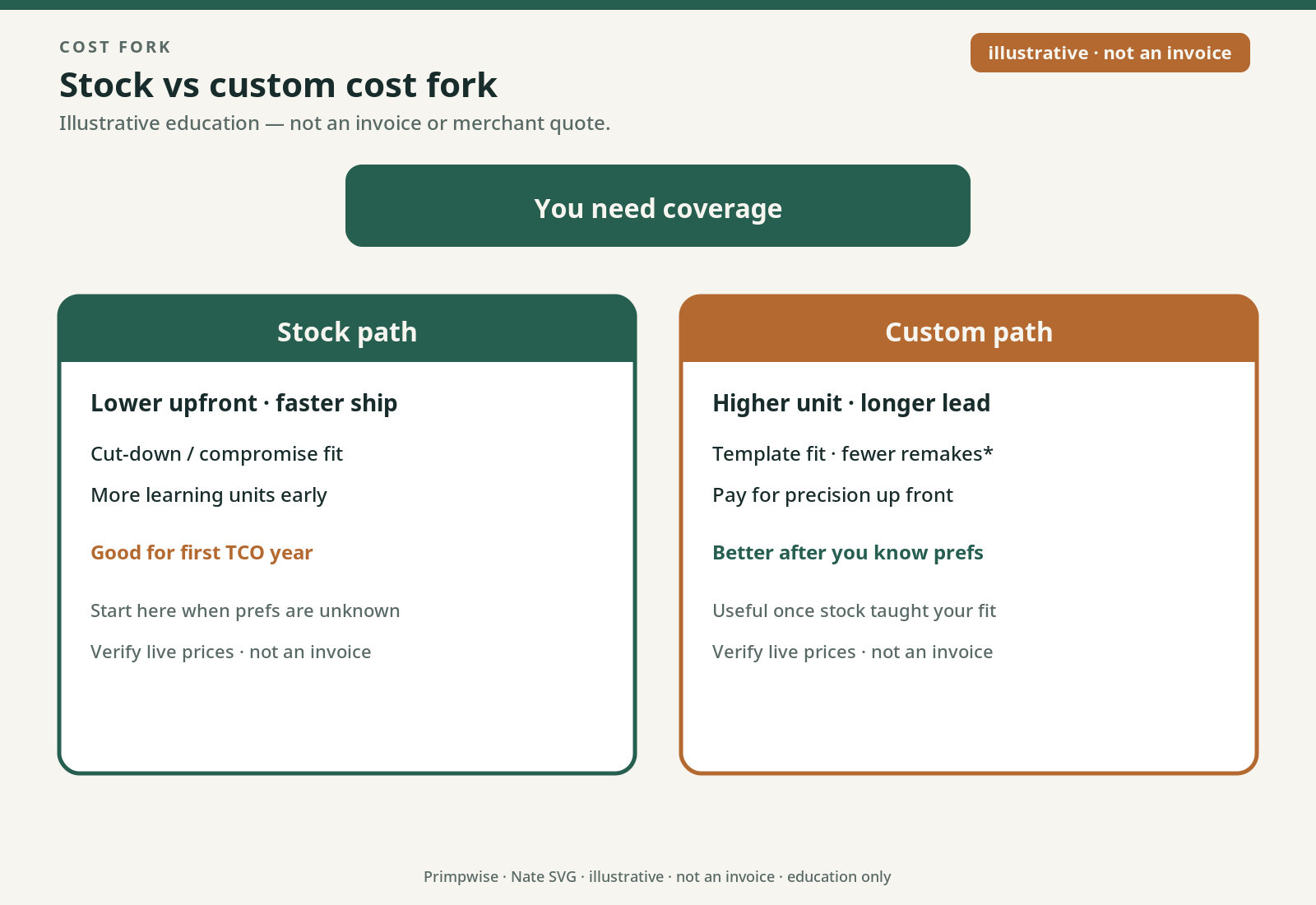
Stock lowers first-order risk and lead time; it is usually the right economic move while learning density and base preference. Custom raises unit price and often tightens returns; it pays off when stock cannot meet size, gradient, or texture—not when the buyer merely wants “premium” as a feeling. Deep fork: stock vs custom.
How to lower annual cost without looking fake
- Pick base for lifespan you can maintain — mono/hybrid for fewer replacements if hairline goals allow; ultra-thin only if you accept higher turnover.
- Start stock and lighter density — reduces “buy again because it looks wiggy” waste.
- Learn DIY reattach after one good cut-in — cuts recurring labor.
- Run a two-unit rotation when cash allows.
- Read return windows before cutting — unworn/uncut rules protect first-order experiments.
- Compare two merchants’ live carts — never assume one blog’s band is the shelf price.
For sequencing these choices with base and install skill, use how to choose a hair system. For entry-focused product framing, see best budget hair systems for men.
Per-day framing (optional sanity check)
Dividing a realistic annual total by 365 helps some buyers compare systems to other appearance spend—but it can also hide cash-flow pain when two units and a salon cut-in land in the same month. Use per-day math only after annual assumptions are honest:
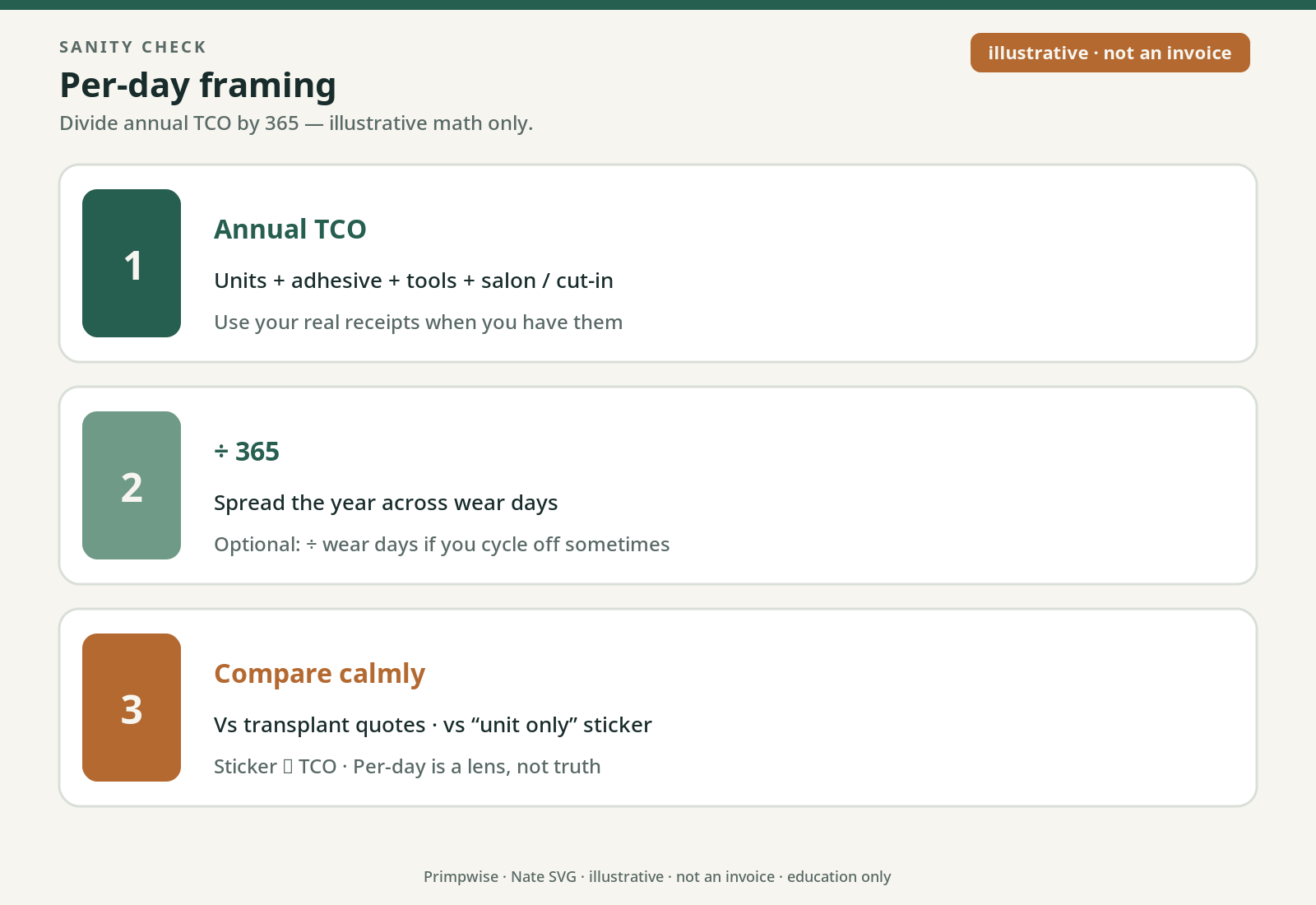
- Short-cycle thin skin at ~$1,600 / year ≈ ~$4.40 / day
- Mid-cycle lace/hybrid at ~$750 / year ≈ ~$2.05 / day
- Longer-cycle mono at ~$450 / year ≈ ~$1.25 / day
These illustrations assume the mid-band unit and accessory placeholders above—they are not invoices. If salon reattaches run monthly, add that labor before calling the habit “coffee money.”
Density mistakes as hidden cost
Over-dense first orders create a special TCO failure: the buyer either lives with a wiggy look, pays a stylist to thin (risking permanent damage), or retires the unit early and reorders. Public density education from Superhairpieces is worth reading before the cart closes (density guide). Starting light / light–medium is usually cheaper than buying the “full” look twice.
Color mismatches create the same early-retire pattern. Match sides/back in daylight; bias lighter when between shades—see the decision order on how to choose a hair system.
Shipping, duties, and regional adhesives
Cross-border orders can add shipping, VAT/duties, and delays that do not appear in USD list prices. Some regions also struggle with adhesive brand availability—factor local salon or pharmacy substitutes into TCO. Community cost questions often come from outside the US; convert live carts to local currency and include import fees before comparing to a domestic transplant quote.
Promotion calendars and “second unit” discounts appear on merchant sites irregularly; treat them as timing tactics, not as proof that a lower everyday shelf price exists. Always screenshot or save the live cart total you actually paid for personal TCO tracking.
Conditional shop paths by budget goal
If minimizing year-one cash while learning → stock thin skin / light density
Lordhair SuperSkin-V · Superhairpieces thin skin · LaVivid thin skin

If paying for breathability / hairline and accepting lace care → lace stock
Lordhair lace · Superhairpieces lace · LaVivid lace
If stock ladders cannot meet fit/texture → custom (after a stock lesson if possible)
LaVivid custom · verify Lordhair / SHP custom forms and lead times live
If the question is surgery instead of recurring units → decision page first
Hair system vs hair transplant — do not buy a system or book surgery from cost tables alone.
What cheap units usually sacrifice
Sub-budget synthetic or thick-base pieces can look detectable under office light even when the cart total feels winning. The point of a men’s system for most readers is social undetectability. Paying somewhat more for human hair and a believable base—then nailing density and cut—usually beats twice-failed ultra-cheap experiments. “Cheapest” claims without live multi-merchant checks are refused here.
FAQ
How much does a hair system cost per year?
Many DIY wearers land in a rough planning band of hundreds to low thousands of USD per year depending on base turnover and salon labor. Use the illustrative table above, then replace every cell with live unit prices and your real attach cadence.
Are cheap hair systems worth it?
Below typical human-hair stock bands, expect tradeoffs in base thickness, fiber, or durability that can increase detectability. Verify fiber type and base mm on the listing; do not assume a low cart total equals a natural result.
Do adhesives really add much?
They add a steady line item and can add salon markup. Budget about $100–$200 / year as a DIY planning placeholder unless your usage is extreme—then track your own receipts.
Is custom always more expensive over time?
Per unit, usually yes. Over years, a better-fitting custom that reduces early retirements can compete—but only if specs truly exceed stock. Most learners should buy stock first.
How do systems compare to transplant cost?
Different cash shapes and risk profiles. Commonly cited surgery ranges are often five figures upfront—verify with clinics. Systems recur. Full compare: system vs transplant.
Closing — budget the cycle, not only the unit
- Pull two live unit prices for the base you actually want.
- Add adhesives + likely salon cut-in.
- Estimate replacements from that base’s public care/lifespan language (not a viral number).
- Decide stock vs custom and DIY vs salon with eyes open.
- Revisit after unit one—real personal TCO beats any blog table.
Shop starting points: thin-skin and lace CTAs above · hub best hair systems for men 2026 · budget spoke best budget hair systems for men · choose hub how to choose a hair system.
Image credits: Cover photo: Stock photo: johnrosman / Wikimedia Commons, CC BY 2.0 (resized); Barber photo: Stock photo: Kawê Rodrigues / Pexels.
Diagrams: self-drawn by Polishwise.
Product images from Lordhair product pages, linked to the source pages.
Product images are merchant images, not photos taken by this site.