A men’s hair system (also called a hairpiece, toupee, or non-surgical hair replacement unit) is a human-hair base bonded to the scalp with tape or liquid adhesive. A hair transplant is a surgical procedure that moves follicles from a donor zone—usually the back or sides of the head—into thinning areas. Both aim at fuller hair, but they differ on cost timing, reversibility, maintenance, and medical eligibility. This page compares those paths so readers can decide by situation—not by a single brand’s soft sell.
We organized the comparison around public buyer decision themes: wanting results now versus waiting through a surgical timeline, upfront cash versus multi-year replacement cycles, donor-hair limits, and whether a reversible trial is preferable before permanent surgery. Unit price bands and lifespan language below are Public specs (as published; verify on brand site). Transplant dollar ranges are commonly cited public education ranges—verify with clinics; this guide does not diagnose candidacy or promise surgical outcomes.
What each option actually is
Hair system. A lace, thin-skin (poly), hybrid, or mono base carries human hair over the thinning zone. When density, color, and cut match bio hair, systems are designed to read as natural at normal social distance. Wear requires attach/clean cycles and eventual unit replacement. Coverage can extend to extensive or near-total loss when a suitable base size is available—something surgery cannot invent if donor supply is short.
Hair transplant. Surgeons typically use FUE (individual follicular extraction) or FUT (strip) techniques to relocate the patient’s own follicles. Transplanted hair that successfully takes is living hair that grows. Eligibility, graft planning, and long-term density depend on donor supply, ongoing androgenetic loss, and surgical plan—questions for a licensed clinician, not a shopping cart.
Public specs comparison
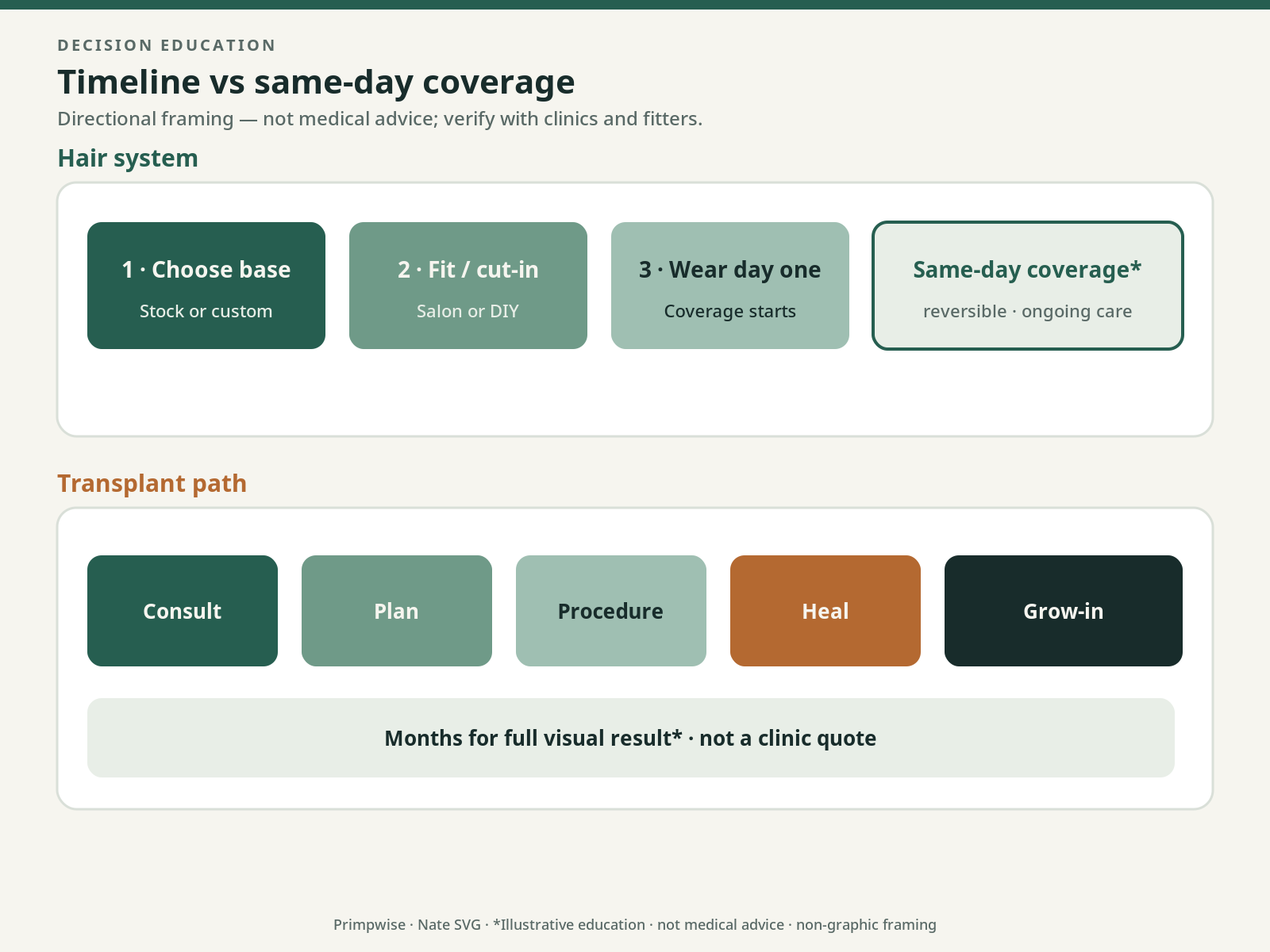
Public specs (as published; verify on brand site). Transplant cells are directional public education themes, not clinic quotes.
| Dimension | Hair system | Hair transplant |
|---|---|---|
| What it is | Non-surgical bonded human-hair unit | Surgical follicle relocation (FUE / FUT common) |
| Upfront cost signal | Multi-merchant stock units often land in the low hundreds of USD per unit (brand bands vary—see table below) | Commonly cited public ranges ~$7,000–$15,000+ per procedure — verify with clinics |
| When coverage shows | Same day after cut-in / attach | Often months of shed-and-grow; final density commonly discussed around 6–12 months — clinic-specific |
| Surgery / recovery | No surgery | Surgery + recovery constraints (sweat, sun, contact—follow surgeon) |
| Ongoing cost | Units + adhesive + care (+ optional salon); base type changes annual TCO | After healing, ongoing unit cost is near zero if results meet goals; revision procedures add cost |
| Reversible | Yes — remove the unit | No — grafts / donor harvest are not “undo” products |
| Donor / coverage limit | Limited by base size and styling, not donor grafts | Limited by donor supply; extensive loss may not reach desired density |
| Maintenance | Bond refresh, clean, replace on a cycle | Post-op care then normal hair care if successful |
| Best if… | Need speed, reversibility, or coverage beyond donor limits | Stable loss pattern, adequate donor, can wait, accepts surgical risk |
| Watch-outs | Adhesive routine; replacement spend; learning cut/density | Timeline; continued native thinning around grafts; cost of revisions |
Multi-merchant unit price signals (systems)
| Source | Public price signal (verify live) | Proof |
|---|---|---|
| Lordhair SuperSkin-V stock | Listed from about $249 USD on the product page (currency switcher present) | Lordhair SuperSkin-V |
| Lordhair Afro hub examples | Public tiles observed roughly $149–$309 depending on model | Lordhair Afro hub |
| LaVivid cost education | Brand article cites lace roughly $250–$290; skin types roughly $100–$299; monofilament roughly $190–$350; also discusses transplant cost as context | LaVivid cost article |
| Superhairpieces | Thin-skin education emphasizes models/features; treat shelf prices as check live listing | SHP thin-skin bestsellers |
These bands are not a single-vendor “market truth.” Year-one system spend also includes adhesives, solvent, shampoo, and often a professional cut-in. For a full ownership walkthrough, see the hair system cost breakdown.
Tradeoffs each side understates
Systems: maintenance is the product
Community cost and beginner themes repeatedly treat systems as a routine, not a one-time purchase. Bond refresh cadence depends on adhesive type, sweat, and lifestyle. Base materials change replacement frequency: public merchant framing often presents ultra-thin poly films as shorter wear cycles and mono / durable hybrids as longer—always re-check the specific listing’s care language. Density mistakes and unfinished cuts drive “looks fake” complaints as often as brand choice.
If the wearer will not learn attach/clean—or pay a stylist for it—a system becomes friction rather than relief. Install channel (DIY vs salon) is a separate decision; see DIY vs salon hair system install when that is the blocker.
Transplants: permanence has conditions
Public education and buyer discussion themes converge on several non-negotiables that shopping pages skip:
- Donor supply caps density. Surgery redistributes existing follicles; it does not create unlimited new ones.
- Native loss can continue. Grafts in a recipient zone can look isolated if surrounding bio hair keeps thinning—revision planning is a clinical conversation.
- Timeline is long. Shed-then-grow phases mean many men cover the interim with hats or, carefully, a system—only with surgeon approval for adhesives.
- Outcomes vary. This guide does not publish success-rate percentages. Ask clinics for their revision policies, graft survival framing, and before/after cohorts relevant to your Norwood stage.
Medical eligibility, medication plans (finasteride, minoxidil, etc.), and surgical risk belong with a clinician—not an affiliate table.
If you need coverage now, reversibility, or limited donor → hair system
A system is usually the stronger first move when any of these are true:
- Results are needed on a days-to-weeks timeline, not a year.
- Hair loss pattern is still changing (younger men often hear clinicians delay surgery until patterns stabilize—confirm with a doctor).
- Upfront five-figure surgery cash is not available or not preferred.
- Loss is too extensive for the density goals a single procedure can fund with available donor hair.
- The reader wants a reversible trial of a fuller hairline before permanent surgery.
- A transplant is already booked (or likely) and interim coverage is needed—only with surgeon clearance for any bond on healing scalp.
Shop starting points (match base to lifestyle):
- Thin skin / simpler cleanup learning: Lordhair SuperSkin-V · Superhairpieces thin skin · LaVivid thin skin
- Lace / breathability / hairline-first: Lordhair lace · Superhairpieces lace · LaVivid lace
- Custom specs after stock learning: LaVivid custom

For multi-brand shortlists by base and budget, use the men’s hair system shortlist. For sequencing base, density, and install skill before ordering, use how to choose a hair system. Stock-first learning before custom lead times is covered in stock vs custom hair systems.
If loss is stable, donor is adequate, and you can wait → transplant consult
A transplant consult is often worth serious time when all of the following lean true (clinician confirms):
- Loss pattern has been relatively stable and age/stage support surgical planning.
- Donor density is adequate for the coverage map you want.
- Upfront cost and downtime fit finances and work life.
- You accept months of transitional appearance and follow post-op rules.
- You have vetted surgeons with verifiable portfolios for your hair type and Norwood stage.
Even then, many men keep a system option open for the growth window or for future recession outside the graft zone. Surgery and systems are not mutually exclusive strategies—they are different tools on different timelines.
Bridge strategy: system now, surgery later (or never)
Buyer hesitation themes often sit between “surgery forever” and “wig forever.” A practical middle path:
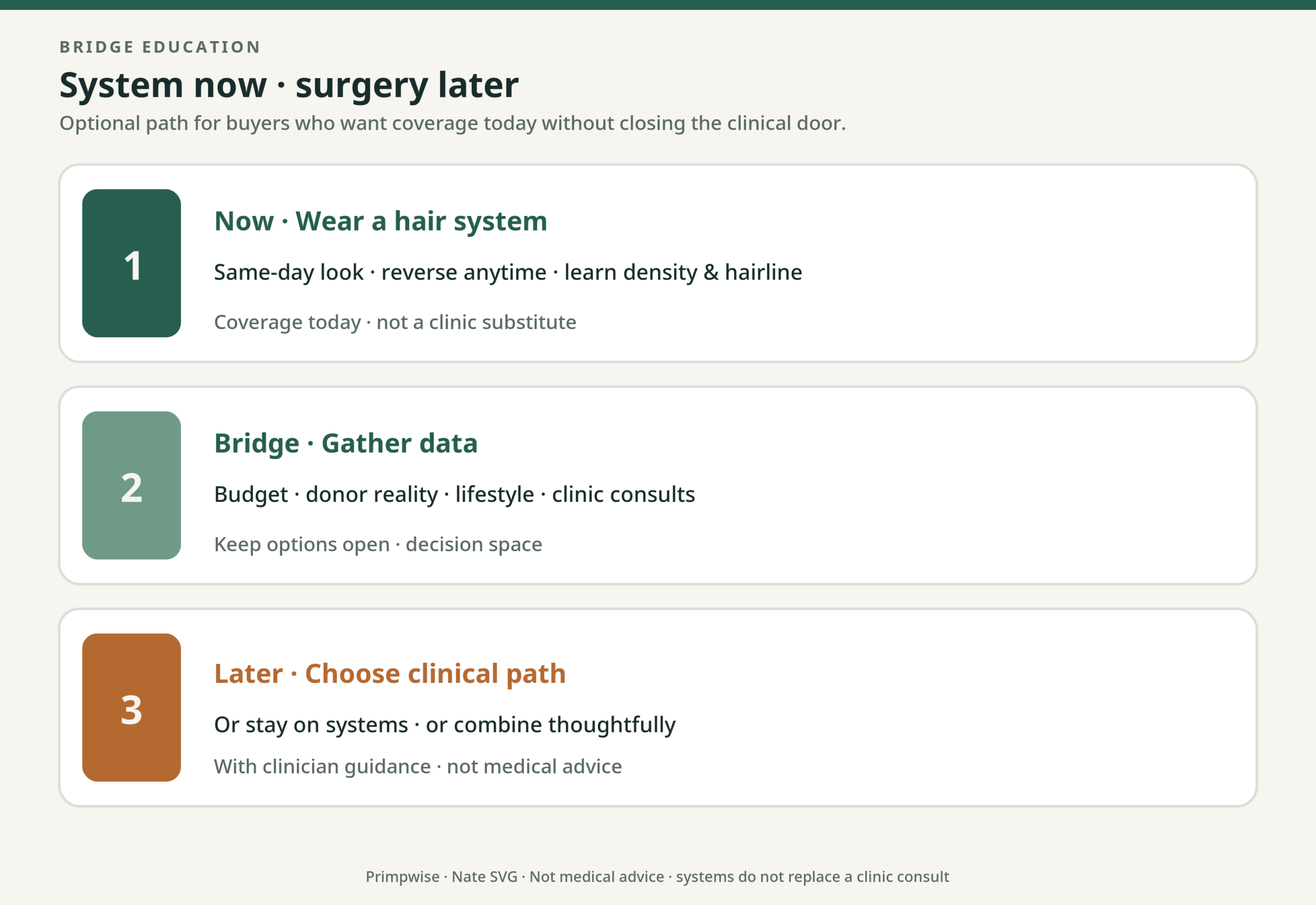
- Restore appearance immediately with a well-cut system.
- Use the calm period to research surgeons without panic deadlines.
- If surgery proceeds, ask the surgeon whether and when any bonded unit is allowed during growth.
- If surgery is declined or deferred, continue systems with clearer base/density preferences already learned.
Some wearers stay on systems for years and never operate. Others treat the system as a bridge. Neither path requires inventing medical guarantees.
Cost timing: cash today versus cash over years
Sticker comparisons that put “one system unit” against “one surgery invoice” mislead on both sides. A fairer frame:
- Systems ask for recurring unit + adhesive + (optional) salon spend. Base choice changes how often units turn over; public merchant lifespan framing is directional and care-dependent. Rotation of two units, careful solvent use, and avoiding bad first cuts all move annual totals.
- Transplants ask for a large single invoice plus time off work, aftercare products, and possible future sessions if loss continues or density goals rise.
- Hidden system year-one costs often include the first professional cut-in, practice adhesive kits, and a learning-unit risk if returns require unworn/uncut condition.
- Hidden transplant costs can include travel to a reputable clinic, medications sometimes prescribed around surgery, and opportunity cost during the growth window.
None of these lines are universal tariffs. Pull live system carts from at least two merchants and written clinic quotes before declaring a “winner.” The hair system cost breakdown walks unit bands, accessories, and annual ownership themes without treating any single factory price list as the market.
Natural look: where each path usually fails
Buyer themes around unnatural appearance rarely blame “the concept of hair” — they blame controllable specs and unfinished work.
For systems, the usual failure modes are density too high for side/back bio hair, an uncut stock silhouette, thin-skin shine under hard light, lace knot visibility when adhesive or bleaching is mishandled, and color that is too dark once bonded. Editorial bias for first units: start lighter on density, plan a system-literate cut-in, and choose lace vs thin skin based on sweat and cleanup skill rather than marketing photos alone. Superhairpieces’ public density education stresses that the same percentage reads differently across thin skin, lace, and mono — treat brand percentages as relative (SHP density guide).
For transplants, visual risk clusters around hairline design that ages poorly, density that looks sparse against expectations sold in consult photos, and later contrast if untreated native hair keeps thinning around grafts. Those are surgical-plan and disease-progression issues — solve them in clinic consults, not in a product FAQ.
Hesitation, medication, and “not ready yet”
Community hesitation themes often mix social fear (“will people notice?”) with medical indecision (“should I stay on medication only?”). A hair system does not require disclosing wear to anyone; disclosure is a personal choice. Medication and topical paths are non-system medical options — this article does not prescribe them. Readers who are not ready for a bonded unit or surgery should pause purchases, consult a clinician for medical options, and return when timeline and budget are clearer. Primpwise’s role here is decision framing and product education, not diagnosing androgenetic alopecia.
FAQ
Is a hair system cheaper than a transplant long term?
It depends on years worn, base replacement cadence, salon labor, and whether a transplant needs revisions. Systems spread cost across units and maintenance; transplants concentrate cash upfront. Run both numbers with live unit prices and clinic quotes—not a single blog’s break-even claim. Start with the cost breakdown.
Can younger men get a transplant?
Many clinicians prefer waiting until patterns stabilize; premature grafting can look odd if surrounding hair keeps thinning. That is a medical judgment. Systems remain a reversible option while waiting for clinical advice.
Do modern hair systems look natural?
When density matches bio hair, color is correct, the hairline strategy fits the base, and the cut is finished, systems are designed for social undetectability. Failures usually trace to over-density, unfinished blend, shine, or color mismatch—not to “all systems look fake.”
What if a transplant underperforms?
Revision options, donor leftovers, and scarring risk are clinic-specific. Ask about revision policy before paying deposits. A system can still provide coverage later; adhesives on operated scalp need surgeon guidance.
Can someone wear a system after a transplant?
Often discussed as an interim cover during growth—but adhesive timing and base weight must follow the surgeon. Do not invent a DIY post-op protocol from a shopping article.
Closing — choose by timeline, cash, and reversibility
- If you need hair this month or want an exit ramp → evaluate systems first.
- If donor, stage, budget, and patience support surgery → get clinic consults, not only ecommerce tabs.
- Price systems across merchants; price surgery as clinic quotes.
- Match system base to sweat, hairline, and skill—then verify the live listing.
- Revisit the choice as loss stage and finances change.
Shop systems (conditional): Lordhair thin skin · Lordhair lace · Superhairpieces thin skin · Superhairpieces lace · LaVivid thin skin · LaVivid lace · LaVivid custom
Image credits: Cover photo: Stock photo: Cleber wendder Nascimento / Pexels.
Diagrams: self-drawn by Polishwise.