Itchy or red scalp under a men’s hair system often gets labeled an “adhesive allergy” in the first anxious search. Many community itch themes describe irritation from residue, solvent prep, occlusion, or rough removal instead — patterns that behave differently from a delayed immune-type response. This page offers editorial differentiation and stop rules, not a diagnosis, not a treatment protocol, and not a cure claim. When in doubt, pause wearing and speak with a clinician. Product-label and prep notes are Public / label guidance (verify on packaging).
Sibling stack for reactive skin and base choices: hair system sensitive scalp guide. Decision gates: how to choose a hair system. Hub: men’s shortlist.
Timing is the fastest practical signal
These are consumer pattern labels, not clinical diagnoses:
| Pattern wearers often call… | Timing / shape (practical) | Typical first consumer step |
|---|---|---|
| Irritation-like | Minutes to hours after attach or peel; stays near the bond outline; burning/stinging | Remove, clean residue gently, let skin rest bare before any reattach |
| Allergy-like / delayed | Often 24–72 hours later; may itch deeply; may spread beyond the tape/glue line; may include swelling or blistering | Stop wearing; see a clinician (dermatology when available) for evaluation — do not self-declare an allergy from a blog |
Editorial “we” note: Primpwise compared public adhesive education themes and wearer pain clusters for structure only — this is not patch-test medicine.
This article cannot confirm which pattern a reader has. Only a clinician can evaluate skin and, when appropriate, order formal testing.
Common non-allergy drivers behind “adhesive reactions”
Before assuming chemistry alone:
- Residue films trapping sweat and sebum against skin after incomplete remover dwell.
- Aggressive alcohol prep stripping the barrier when used too often or on broken skin.
- Skipping a barrier product some wearers use between adhesive and scalp (still patch-check anything new).
- Long occlusive wear without refresh — heat and moisture under the base.
- Dry-peeling instead of dissolving adhesive — mechanical abrasion that looks like a “reaction.”
- Sensitization over months — rare relative to residue issues; escalating reactions on re-exposure belong with a clinician, not endless brand hopping.
Sweat and oil acceleration of perimeter problems: hair system sweat and oil management.
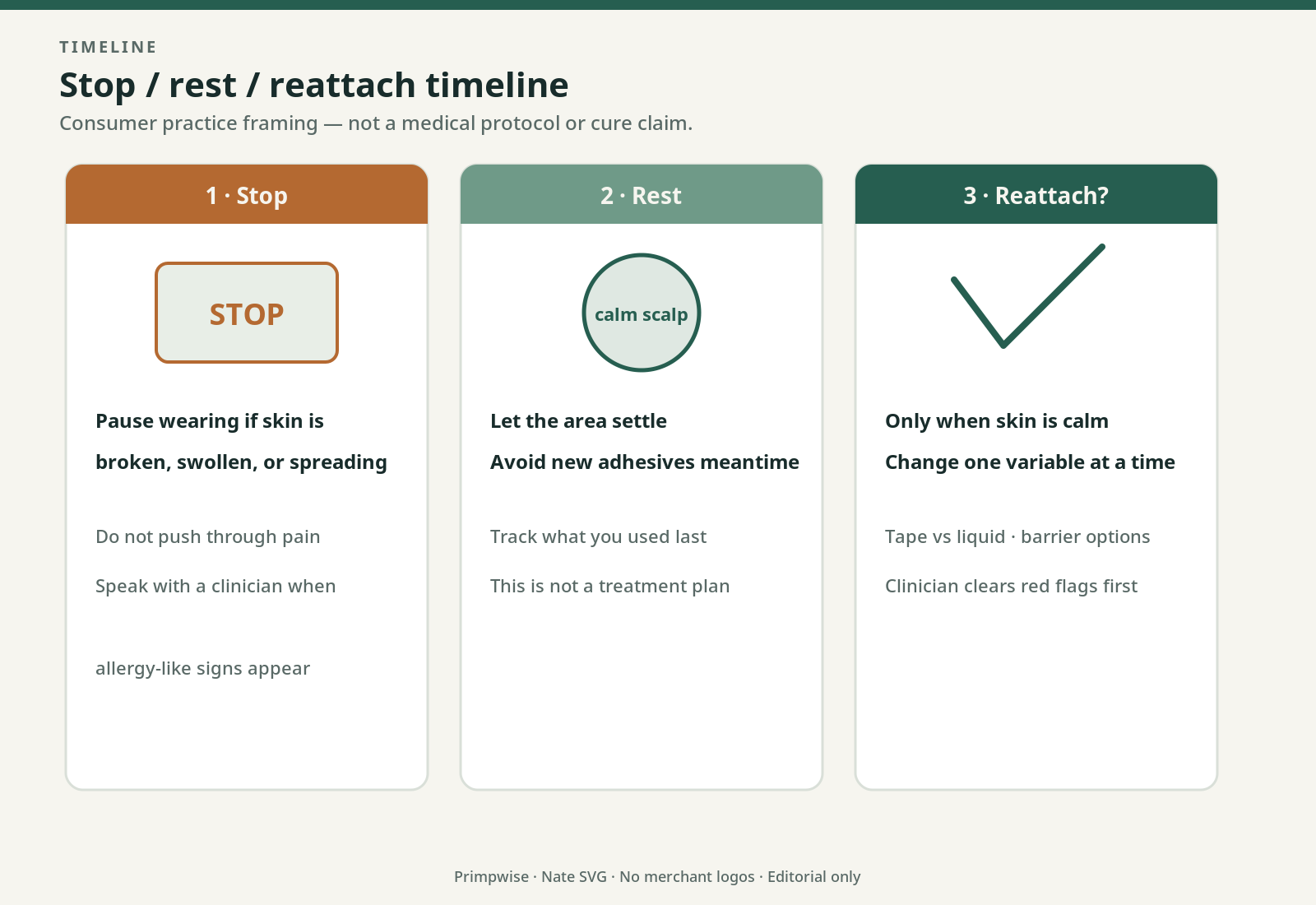
Consumer practice: stop, rest, then reconsider variables
General consumer practice — not a medical protocol:
- Stop wearing if skin is broken, weeping, blistering, spreading, or painful beyond mild settling itch.
- Remove with a purpose-made remover; allow labeled dwell time; avoid scrubbing raw skin.
- Let the scalp rest bare (many wearers use on the order of 48–72 hours when irritation-like symptoms were mild and localized — this is a common community rest window, not a prescribed cure).
- Change one variable at a time later (prep, tape vs liquid, wear days) — see sensitive scalp guide.
- Patch-test language as consumer caution: some wearers apply a small amount of a new adhesive on intact inner forearm for about 48 hours and watch for delayed redness before full-scalp use. That is a personal risk-reduction habit, not a substitute for clinical patch testing and not a guarantee of safety.
“Hypoallergenic” on packaging is not a regulated promise of zero reaction for every person.
When to see a clinician
Seek clinical care rather than another SKU experiment when:
- Symptoms appear a day or more later and include swelling, blistering, or spreading beyond the bond zone.
- Reactions worsen each re-wear cycle.
- Signs that could indicate infection appear (increasing warmth, discharge, fever) — remove the unit and get medical attention.
- The reader is already under dermatology care for eczema, retinoids, isotretinoin, or other barrier-altering treatments — attach only when that clinician’s guidance allows.
Primpwise does not diagnose, prescribe, or claim to cure adhesive reactions.
Tape vs liquid (practical, not clinical)
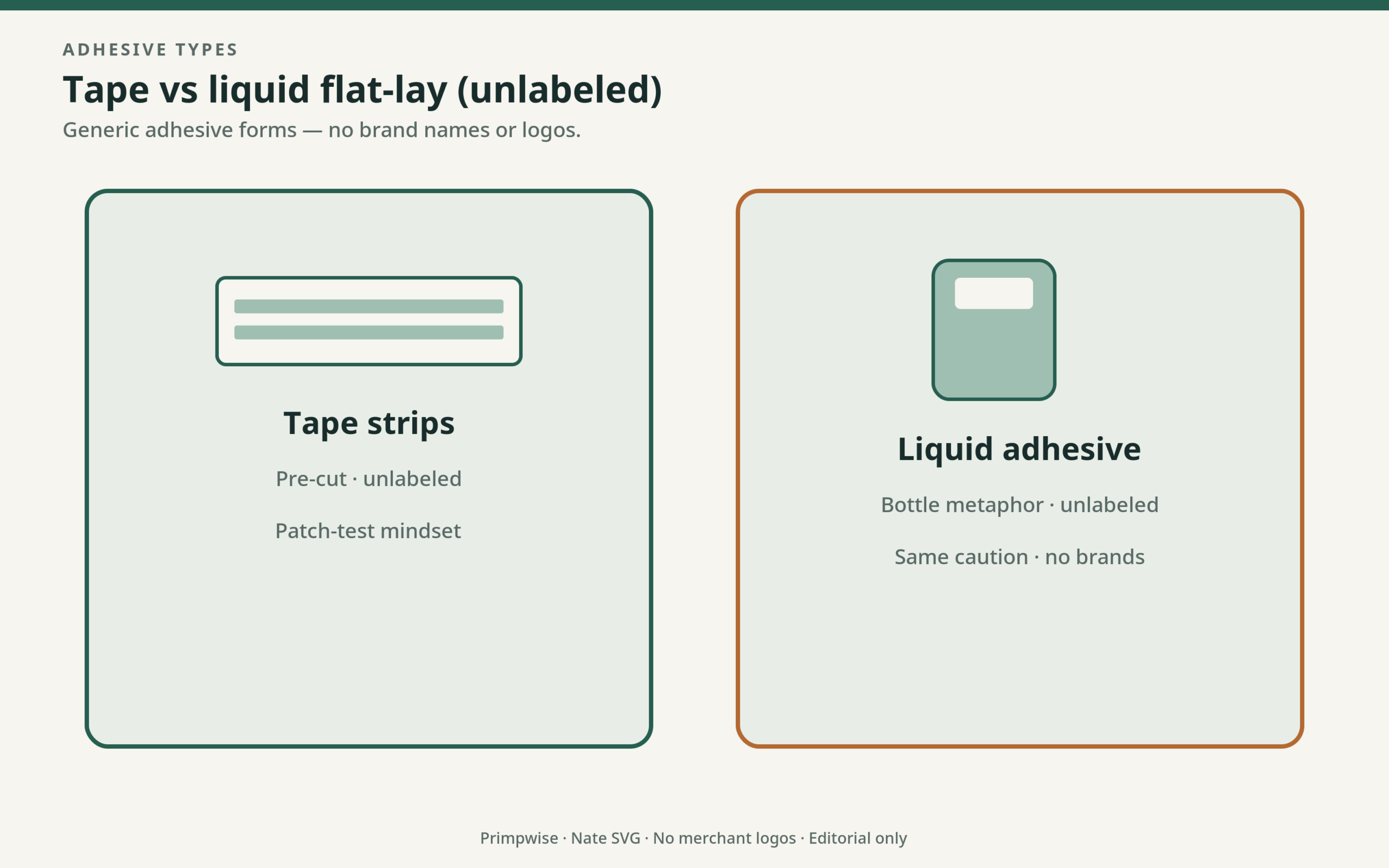
Many reactive-skin wearers prefer tape on lace and cautious liquid use only on poly zones after calm skin — because liquid can saturate the barrier differently. That is a maintenance preference discussed across merchant adhesive education and wearer communities; it is not a medical ranking. Base implications: lace hair system guide · thin-skin hair system guide · lace vs thin skin.
Lordhair and Superhairpieces publicly merchandise lace and thin-skin families that pair with different adhesive habits (Lordhair lace; SHP thin skin).
Quick self-check before blaming the brand
- [ ] Residue fully cleaned from last cycle?
- [ ] Reaction within hours and localized? (irritation-like pattern — still not a diagnosis)
- [ ] Reaction 24–72 hours later or spreading? → clinician, not another glue jar
- [ ] Wear stretched far beyond a comfortable refresh window?
- [ ] Heavy alcohol prep or dry-peel trauma?
- [ ] Skin already compromised before attach?
Conditional shopping only after skin is calm
Do not shop through an active flare. After calm skin and (when needed) clinical clearance:
If lace / tape-first / more venting: Lordhair lace · Superhairpieces lace · LaVivid lace
If thin skin / simpler cleanup once chemistry is tolerated: Lordhair SuperSkin-V · Superhairpieces thin skin · LaVivid thin skin

Building a lower-drama routine (still not medicine)
Most recurring scalp complaints in wearer communities track maintenance, not mystery chemistry:
- Every reattach: dissolve adhesive with labeled remover; clean scalp and base; allow skin to dry fully; consider a consumer barrier product if previously tolerated.
- On a regular cadence: full remove rather than endless stretch “because it still holds.”
- After heavy sweat: blot and inspect; shorten the cycle instead of adding harsher glue (sweat and oil; gym).
If mild localized symptoms clear after a bare rest window and careful reattach, process improvement was likely the lever. If symptoms return faster and worse each cycle, stop experimenting and involve a clinician.
Ingredient marketing vs personal history
Public adhesive labels may mention water-based formulas, “sensitive” lines, or latex-free claims. Those headlines are starting points for reading a label — not proof a given scalp will tolerate them. Personal history with acrylates, fragrances, or solvent prep matters more than adjectives. Formal identification of allergens, when needed, is clinic work.
FAQ
Can someone keep wearing through irritation?
Continuing through broken or spreading reactions usually prolongs recovery. Remove and reassess; involve a clinician when patterns look delayed or systemic.
Does “hypoallergenic” mean safe for everyone?
No. Treat the word as marketing language; personal history and clinician guidance matter more.
Is a forearm dab a medical patch test?
No. It is an informal consumer caution some people use. Formal allergen identification belongs in clinic.
Where should reactive-skin base choices go next?
Sensitive scalp guide and how to choose.
Closing
Separate irritation-like process problems from delayed spreading patterns that need a clinician. Stop wearing when skin is compromised, avoid cure claims, and only return to product decisions via the men’s shortlist after skin is calm.
Image credits: Cover photo: Stock photo: Ksenia Chernaya / Pexels; Stock photo: Stock photo: Towfiqu barbhuiya / Pexels.
Diagrams: self-drawn by Polishwise.
Product images from Lordhair product pages, linked to the source pages.
Product images are merchant images, not photos taken by this site.