A thin-skin (polyurethane / poly / PU) men’s hair system uses a solid, skin-like film base that lies flat on the scalp. Hair is injected, V-looped, or — on thicker films — knotted into the membrane. This page is an education guide: what thin skin is, how thickness tiers trade realism for durability, adhesive and care differences vs lace, and who it fits. It is not a multi-brand Best-of ranking — for conditional SKU shortlists see best thin skin hair systems for men. Side-by-side tradeoffs: lace vs thin skin. Hub: men’s shortlist. Specs are Public specs (as published; verify on brand site).
What “thin skin” means
In retail copy, “poly,” “skin,” “PU base,” and “thin skin” usually describe the same material family: a continuous polyurethane membrane rather than an open mesh. Why buyers choose it:
- Flat surface can mimic scalp when base tint and edge trim match.
- Smooth film gives consistent tape/liquid contact.
- Residue cleanup is often a wipe rather than a long lace soak.
- Hairline can look polished immediately after a clean attach.
The cost of that sealed surface: less airflow than lace, and — on the thinnest films — shorter published wear cycles and more careful handling when wet or during solvent cleaning.
Thickness tiers (read the millimeters)
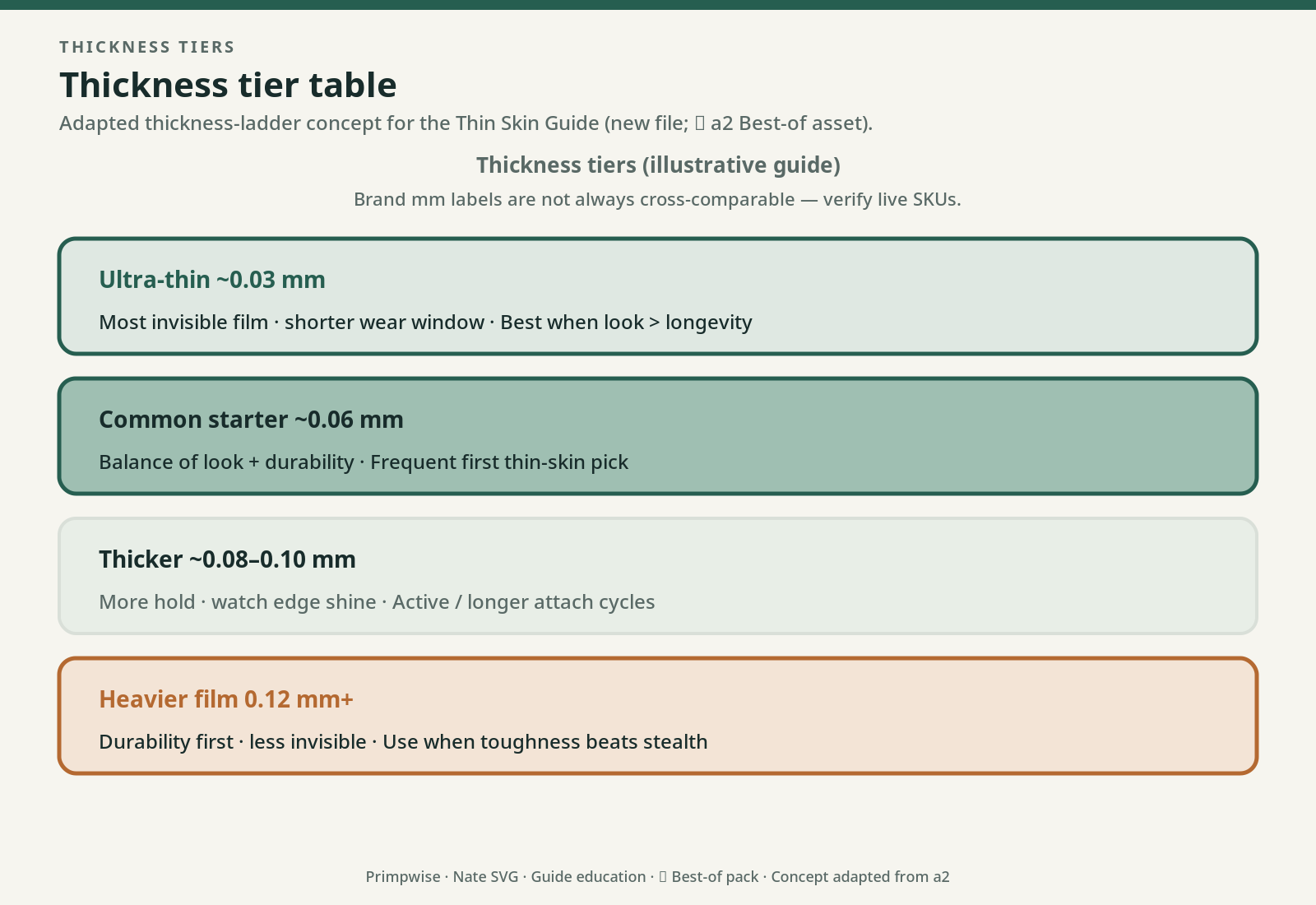
Industry names are loosely standardized. Always read the exact mm on the listing:
| Industry tier (typical language) | Typical thickness band | Optimizes for | Trade-offs |
|---|---|---|---|
| Ultra-thin skin | ~0.02–0.03 mm | Maximum edge invisibility | Fragile; shortest cycles; easy to tear with aggressive cleanup |
| Super-thin skin | ~0.04–0.06 mm | Common “balance” tier | Still not mesh breathability; edge slightly easier to spot than ultra-thin |
| Thin skin | ~0.08–0.10 mm | Tougher handling | Less invisible at the perimeter |
| Thicker bio-skin / PU | ~0.12 mm+ | Durability / forgiveness | Least scalp-like edge vs ultra-thin |
Inverse rule: on solid PU, invisibility and durability usually trade off. Be skeptical of marketing that pairs extreme thinness with very long promised lifespan — that fights how thin polyurethane fatigues during peel and solvent cycles.
Public beginner-oriented example often cited: Lordhair’s SuperSkin-V stock framing around a thin V-loop skin unit (about 0.06 mm and medium-light density on the public stock card — verify live) (SuperSkin-V). Superhairpieces publishes a dedicated thin-skin hub. LaVivid’s public cost education discusses skin vs lace vs mono categories as published bands to re-check live (LaVivid cost article).

How hair meets the skin base
Solid skin has no mesh holes. “Breathability” is not lace-style airflow through the base; it is about climate, perimeter bonds, and how hair is fixed:
| Method | Meaning | Wear notes |
|---|---|---|
| V-loop | Hair loops through the membrane without surface knots | Often the most “growing from scalp” look; freestyle parting when well executed |
| Injected | Hair fixed at a set angle | Very clean surface; more directional styling |
| Knotted (thicker skins) | Knots into thicker PU | Strong retention; tiny knot dots possible |
Some factories offer perforated skin or skin-with-gauze for handling or modest sweat egress — still not lace-level venting.
Adhesive on thin skin
Both tape and liquid bond generally perform well on smooth PU.
| Approach | Notes |
|---|---|
| Double-sided tape | Fast for beginners; predictable cleanup |
| Liquid bond | Strong continuous look; follow cure time before sweat/water |
Unlike lace mesh, liquid bond on solid PU does not wick into open weave the same way — lace still wants tape on the mesh (lace guide). In hot, sweaty conditions, closed PU traps heat and oil at the perimeter faster; expect shorter cycles (gym · swim).
Editorial bias for first attaches: start with tape for several cycles, then experiment with liquid if desired.
Care that protects the film (not just the hair)
- No hard heat aimed at the base — thin PU can warp; air-dry ultra-thin when possible.
- Handle wet gently — wet film can stretch; permanent deformation means the base will not lie flat.
- Detangle dry before washing when practical.
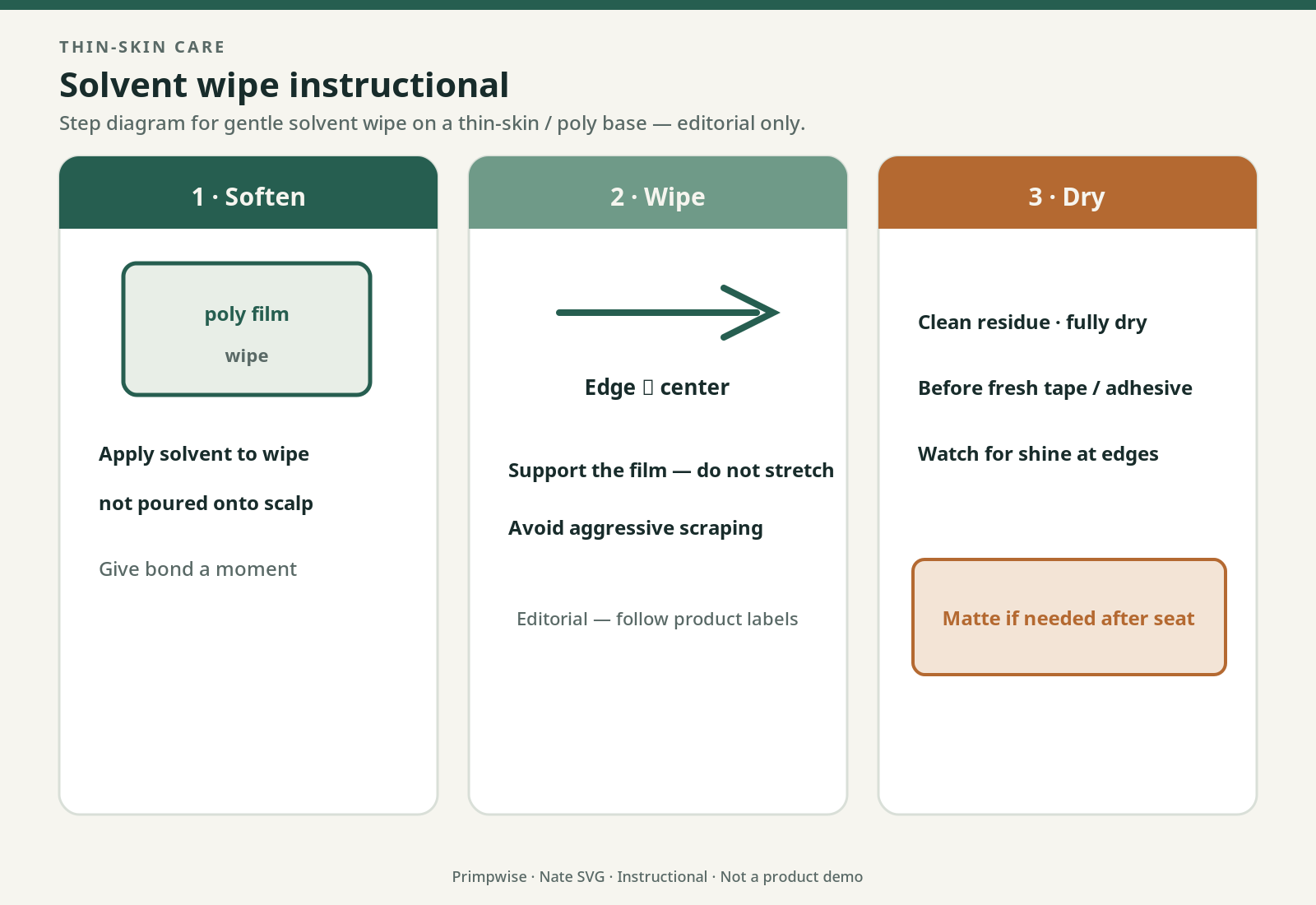
- Wipe residue with solvent on a pad — avoid prolonged soaking that can cloud ultra-thin films; never use acetone (it can dissolve PU).
- Store on a form — do not fold.
First-week discipline: first-wear checklist.
Who thin skin fits
Strong match: hairline invisibility priority; moderate lifestyle (not daily HIIT heat); professional/social polish; willingness to replace thinner films more often; preference for wipe cleanup.
Weaker match: heavy daily training or hot humid climates; lowest annual unit cost (lace/hybrid often win on TCO — cost breakdown); absolute beginners who may tear ultra-thin films during early removals — consider hybrid or a slightly thicker tier, or salon help (DIY vs salon).
Density still makes or breaks realism: same % often looks lighter on thin skin than on mono (SHP density guide).
Heat, comfort, and honest expectations
Polyurethane blocks evaporative cooling under the covered area. Warm climates and hard training increase discomfort risk for some wearers — a category reality, not a scare slogan. If airflow is non-negotiable, read lace vs thin skin and prefer lace or hybrid. Practical irritation themes belong in care and future sensitive-scalp education — this page does not diagnose allergy.
Conditional CTAs
If thin skin is the gate: Lordhair SuperSkin-V · Superhairpieces thin skin · LaVivid thin skin
If lace/breathability wins instead: Lordhair lace · Superhairpieces lace · LaVivid lace · education sibling lace hair system guide
If custom contour/thickness: LaVivid custom when stock cannot meet the spec.
For which brands/SKUs to shortlist after this education, use the thin-skin Best-of — Best-of = who to buy; this page = what thin skin is.
FAQ
Is thin skin hotter than lace?
Generally yes — sealed film vents less than mesh. Ultra-thin helps slightly vs thick PU but does not match lace airflow.
Can thin skin look fake?
Usually from edge visibility, over-density, or shine — not from the word “poly.” Match density, use matte finish, trim the base to the bald area.
How to clean residue without tearing the film?
Solvent on a pad, wipe one direction, short dwell for stubborn spots — no acetone, no aggressive scrubbing on ultra-thin.
Thin skin vs hybrid?
Hybrid (lace top + PU perimeter) keeps tape-friendly edges with better top breathability. Many first-time buyers prefer hybrid when full poly heat is a concern.
Where do prices land?
Do not invent SKU prices here. Use merchant public hubs and the cost breakdown; treat any published band as verify-live.
Stock vs custom for thin skin
Most men should prove density, color, and cleanup skill on stock thin-skin before paying custom lead times for ultra-specific contours. Stock vs custom fork: stock vs custom. Beginners: best hair systems for beginners. When ready to pick merchants after education, the thin-skin Best-of is the shopping spoke — this page stays definitional.
Closing
Thin skin is the scalp-like edge and cleanup family — with heat and lifespan tradeoffs. Lock thickness tier and lifestyle, compare on lace vs thin skin, then shortlist on the thin-skin Best-of and men’s hub. First-order path: how to choose.
Image credits: Barber photo: Stock photo: Alex Urezkov / Pexels; Cover photo: Stock photo: Resource Boy / Pexels.
Diagrams: self-drawn by Polishwise.
Product images from Lordhair product pages, linked to the source pages.
Product images are merchant images, not photos taken by this site.